
Compare the Meanings of Rooks County Property Value
The word value is not one field. Rooks County assessment records follow the Kansas system, which begins with appraised fair-market value as of January 1 and applies the legal classification rate to reach assessed value. A transfer record supplies a different historical data point. Read the label, date, and source before comparing figures.
| Value | What It Is | Where |
|---|---|---|
| Appraised value | County estimate of fair-market value as of January 1 | Rooks County Appraiser |
| Assessed value | Appraised value multiplied by the Kansas class rate | Assessment and tax record |
| Last sale or consideration | Amount or transfer clue tied to a conveyance, when shown | Recorded deed |
| Taxable amount | Value remaining after applicable exemptions or adjustments | Tax roll or statement |
Classification rates differ by property type in Kansas. Residential property carries an 11.5 percent assessment rate against appraised value. Vacant lots use 12 percent, while commercial and industrial property sits at 25 percent. Agricultural land is assessed at 30 percent of use value, public utilities at 33 percent, and other property at 30 percent. These are classification rules, not tax rates or forecasts of a sale price.
Rooks County Values Run on a January 1 Clock
The Appraiser determines market or fair-market value as of January 1 each year. That date matters when comparing a parcel card with a later sale, renovation, storm loss, or listing. Two sound sources can disagree because they describe different dates.
Valuation notices are generally mailed around March 1. A notice reports an assessment-year decision, while a deed reports a transfer event and a private appraisal uses its own stated effective date and purpose. Rooks County also reinspects one-sixth of county data each year and conducts final real-estate review from November through February. Those cycles can change descriptive facts or valuation inputs without establishing a sale price.
Kansas Class Rates Shape Rooks County Assessed Value
The state formula is simple. Appraised value multiplied by the assessment rate equals assessed value. That is why a residential assessed value sits far below its appraised figure without any suggestion that the home lost most of its market worth.
| Property class | Rate | Comparison rule |
|---|---|---|
| Residential | 11.5% | Apply to appraised value |
| Vacant lot | 12% | Class changes the assessed figure |
| Commercial or industrial | 25% | Do not compare directly with residential |
| Agricultural land | 30% of use value | Use value differs from market value |
Property tax builds on assessed value and the mill levy. The Rooks County property tax records page covers the bill and the appeal path.
Locate a Rooks County Property Value Record
Start with the Rooks County Appraiser or ORKA, searching by address, owner name, County ID, or section-township-range where those modes are offered. Rooks County publishes no stable parcel-result screen for online lookup. Use the office as the fallback and ask for the current parcel card.
- Search ORKA by complete address, then save the Rooks parcel ID exactly as displayed.
- Open the parcel detail if available or ask the Appraiser for current and prior value fields.
- Record property class, appraisal year, appraised value, assessed value, and any exemption flag.
- Compare prior years only when each effective date and classification are clear.
- Ask the Register of Deeds for the latest instrument when a sale clue is needed.
- Assessed value
- The class-adjusted figure used in the Kansas tax calculation.
- Market or appraised value
- The Appraiser's fair-market estimate as of January 1.
- Assessment ratio
- The legal percentage applied for the property's class.
- Sale consideration
- A transfer amount or recital that may need deed context.
Rooks County Has Several Value Clocks
One parcel can carry several clocks. There is the annual January 1 appraisal. There is a deed recorded on its transfer date. A tax statement is issued later, and perhaps a private appraisal carries another effective date. Comparing those amounts without their dates creates a false trend. Build a chronology instead. For each figure, record the source, label, amount, and date. A recorded sale can serve as market evidence. Family, estate, corrective, or partial-interest transfers should not be treated as ordinary sales without reading the deed.
Exemptions Can Shift a Rooks County Taxable Figure
Kansas exempts certain defined property classes from taxation. The parcel record itself should show the actual exemption flag. Never infer eligibility from a mailing name or a land use. An exemption changes the amount exposed to the levy. It does not change the underlying fair-market estimate.
The statewide list spans government, charitable, religious, agricultural, household, renewable-energy, military, vehicle, and other statutory categories. The parcel record controls.
Rooks County Market Notices Show Trends, Not Quotes
The county's assessment-year 2025 market study reported upward trends for residential, commercial, and vacant-lot categories. That is mass-appraisal evidence. It is not a parcel-specific offer or guarantee. Ask whether the subject shares the same class, location, use, condition, and effective date. A county trend can explain a change while still leaving parcel-specific facts to verify.
The Rooks County Appraiser Holds the Value Record
The official Rooks County Appraiser page names the office responsible for appraisal records. It serves as the fallback when ORKA does not expose a stable parcel card.
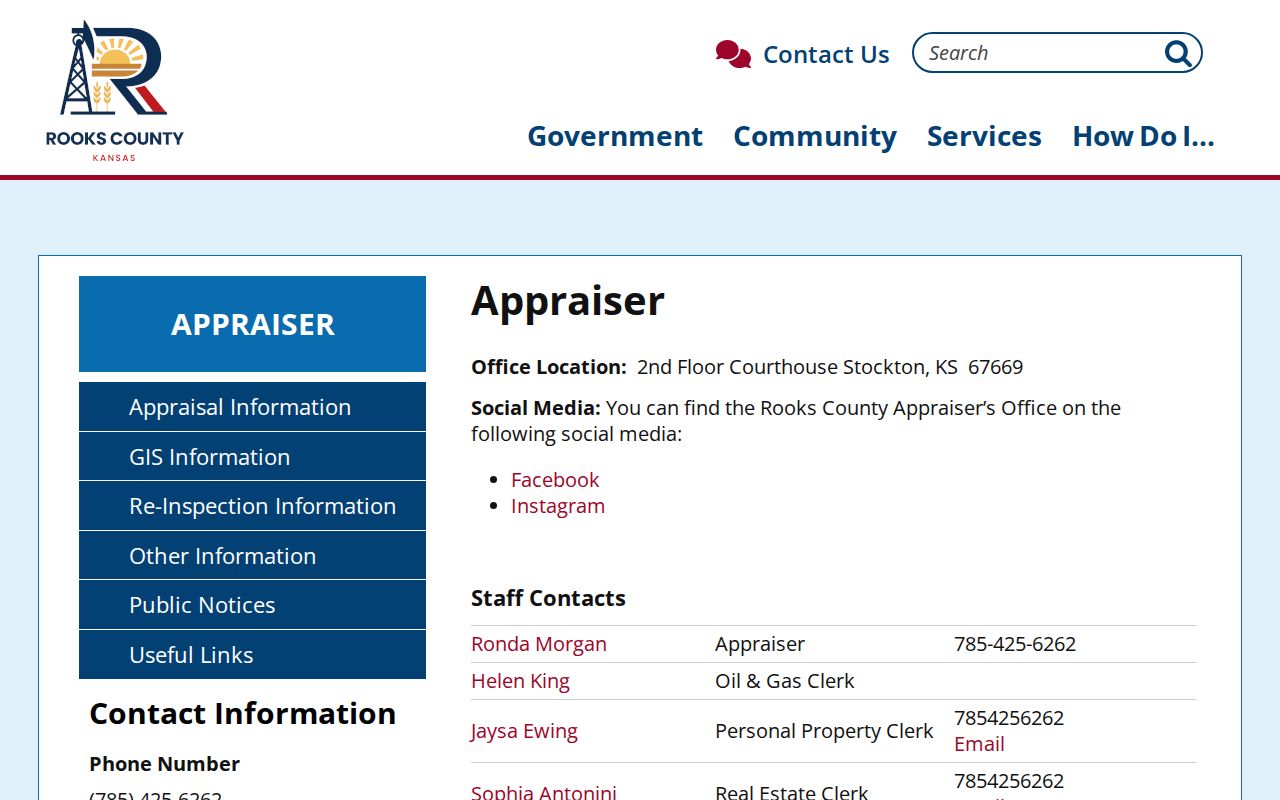
The office page is not a parcel result. Request the current record, and label every property value by year.
What a Rooks County Property Value Cannot Prove
Mass appraisal exists to support consistent taxation across many parcels. It cannot predict a buyer, certify building condition, fix a boundary, or replace a title examination. A licensed appraisal answers a defined valuation question with a stated scope and effective date.
Value vs price. Rooks County assessed value is a tax-calculation figure. It is not the price a property would sell for and is not a private appraisal.