
Move a Palco Address Across County and City Files
No city assessor or recorder serves Palco. Rooks County carries the land records. ORKA and the Appraiser establish the parcel, the Register of Deeds supplies title evidence, the Treasurer handles the taxes, and Palco City Hall rounds out the picture with permits and zoning.
- Search the complete Palco address in ORKA and copy the parcel ID.
- Test the Original Townsite name, block, and lot for an older parcel.
- Request the deed and recorded plat through Rooks County.
- Confirm appraisal and tax fields with their county custodians.
- Ask Palco for permit, plat, inspection, zoning, and final-action records.
The Rooks County property search walks through the county route. Palco adds a block-and-lot code and paper permits.
Rooks County Custody and the Palco Clerk's File
Palco keeps its own local file. The city clerk and superintendent hold applications, approvals, inspections, maps, and the zoning trail, while the Rooks County offices in Stockton keep land title, assessment, tax, and court material.
Rooks County land records
County offices hold every Palco parcel's deeds, appraisal, tax, and map records.
Main, Ash, and Fir Define Palco's Business District
Palco's zoning code maps its business district precisely. It covers a half-block along Main between Ash and the Main/Fir intersection. Two groups of lots appear. The code names Lots 13 through 15 in Block 45 of the Original Townsite and Lots 1 through 4 in Block 2 of “Palco, City of Original 1.” That specificity beats a generic downtown label. Quote the exact street, lot, block, and townsite terms in every county and city request.
Palco's 67657 Postal Label Is Not a Boundary
ZIP 67657 tracks mail routes. It says nothing about city limits. Rural land can carry a Palco mailing address yet sit wholly outside the municipality. Keep four facts separate: the ORKA situs, the Appraiser mailing address, the USPS result, and the clerk's municipal-status answer.
The county's Palco, Damar, and Zurich business directory confirms local address habits, not boundaries. A directory entry proves no border. Compare the full USPS address with ORKA geometry first. Then ask the city clerk whether an annexation ordinance or a filed map places the tract inside Palco.
Palco's Verified History Begins with an 1888 Founding
Palco's official page dates its founding to 1888. Claims about incorporation, a moving depot, and fires appear elsewhere but lack official sourcing. None of them should explain a title. Before tying any date to a parcel, ask the city, the Kansas Historical Society, and the Register of Deeds for a sourced plat and annexation chronology.
Palco Townsite Terms in the Recorded Landscape
Only two formal townsite references hold up, so present each exactly. The business-district lots offer a third, honest grouping.
| Neighborhood / Subdivision | Era | In the Records |
|---|---|---|
| Original Townsite | Historic; exact plat date not stated | Block 45, Lots 13-15 appear in zoning code |
| Palco, City of Original 1 | Historic; exact date not stated | Block 2, Lots 1-4 appear in code |
| Main/Ash/Fir business area | Current code description | Use street and lot/block wording together |
Pull both plats from the Register of Deeds. Lay them beside the city map and the Rooks County parcel map, since a zoning description never sets a title boundary.
Palco's Paper Permit Captures a House Timeline
A Palco permit application captures a house timeline. The clerk keeps the approved permit. The form records the owner, location, proposed work, floor and basement dimensions, occupancy, construction, materials, estimated cost, start and completion dates, contractor names and addresses, and other pertinent detail, with the superintendent acting as chief building official.
| Permit field | History clue | Follow-up record |
|---|---|---|
| Owner and location | Applicant identity at the time | Compare with county deed |
| Dimensions and occupancy | Scope and intended use | Plans and inspection |
| Materials and estimated cost | Construction character | Invoices if publicly retained |
| Start and completion dates | Work chronology | Final approval or correction notice |
Permits lapse after six months unless work begins. The code sets initial and later inspections at $5 plus actual expense, so recheck current charges with the clerk.
Palco Has No Verified Online Permit Results
Palco publishes no online permit lookup. There is no address search, permit-number field, status filter, grid, export, or document viewer. A blank web page proves nothing. A paper permit may still exist, so write the clerk with the full address, the owner if known, the permit type, the date range, and the plans, inspection results, final approval, zoning decision, or correspondence wanted.
The Palco Building Code Documents the Clerk Route
The official Palco building-code article spells out each rule.
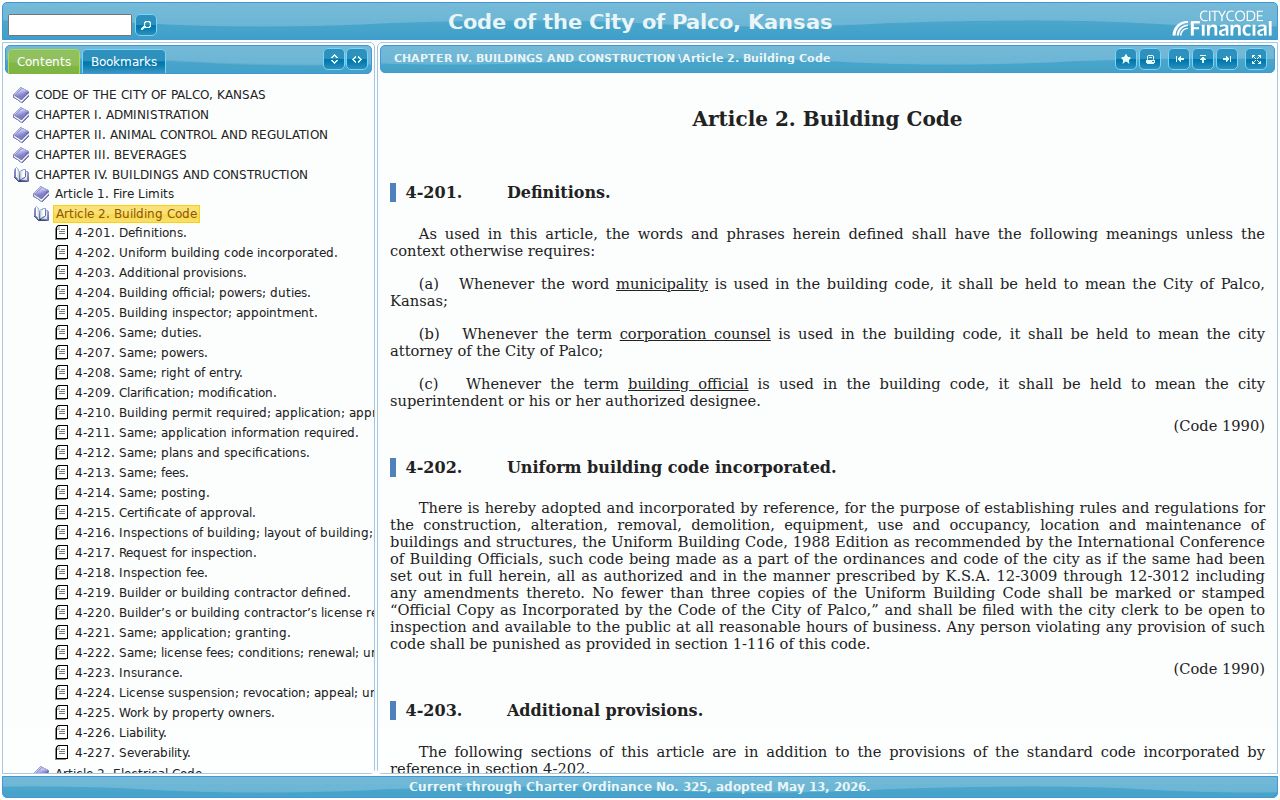
The code page supplies requirements, while the actual applications and results remain city-held records.
Palco City Services Do Not Prove Parcel Ownership
Palco's page lists water, sewer, trash, and office services. It offers no utility-account owner lookup. City services never prove land ownership. A business directory or state entity filing can normalize a name, but neither shows the business holding title. Carry the exact legal entity name into the county deed request, and treat the Appraiser owner field only as a starting point.
Palco Values Require County-Level Context
Rooks County's 2025 notice reported rising residential, commercial, and vacant-lot values. No Palco-only percentage appeared. Obtain the parcel's year, class, land and improvement values, exemptions, and transfer details before drawing any conclusion. Consideration, assessed value, and trend each carry different dates.
Limits of Palco Property Records
These records show plenty. Palco property records document the owner of record, legal description, mapped tax parcel, assessed figures, recorded interests, zoning classification, and the permit and inspection trail. Occupancy, title, surveyed lines, structure, and price stay unproven.
Lawful use. Use Palco property records for due diligence, land history, boundary questions, and civic transparency. They are not a title search, and owner data must never be used to harass or target anyone.