
Read Rooks County Deed Types
A deed records a transfer or a claimed transfer of an interest. Its legal effect depends on the instrument and its terms. The recorder publishes no complete menu of accepted document types. So the common instruments described here are ones worth asking for. They are not a guaranteed list of web filters.
| Deed Type | What It Does | Common Use |
|---|---|---|
| Warranty deed | Conveys the stated interest with warranties | Ordinary sale |
| Quitclaim deed | Conveys whatever interest the grantor has | Interest cleanup or family transfer |
| Trustee deed | Conveys under trust authority | Trust-held land |
| Executor or administrator deed | Conveys through estate authority | Probate sale |
| Tax or sheriff deed | Records a transfer after a legal sale process | Tax or court sale |
A mortgage, lien, or easement is not a deed. It can burden or shape an interest without transferring the whole property. A later release is recorded as a new instrument. It never erases the original filing. Both chains matter. So search the transfer chain and the related encumbrance chain side by side.
The Rooks Recorder Has No Web Index
The Rooks County Register of Deeds page lists duties and copy costs. It offers no searchable grantor-grantee database. It names no first online year or image cutover. It also names no update schedule, subscription rule, result limit, or fraud-alert signup. That distinction matters. Treat the office page as contact information rather than a working deed search.
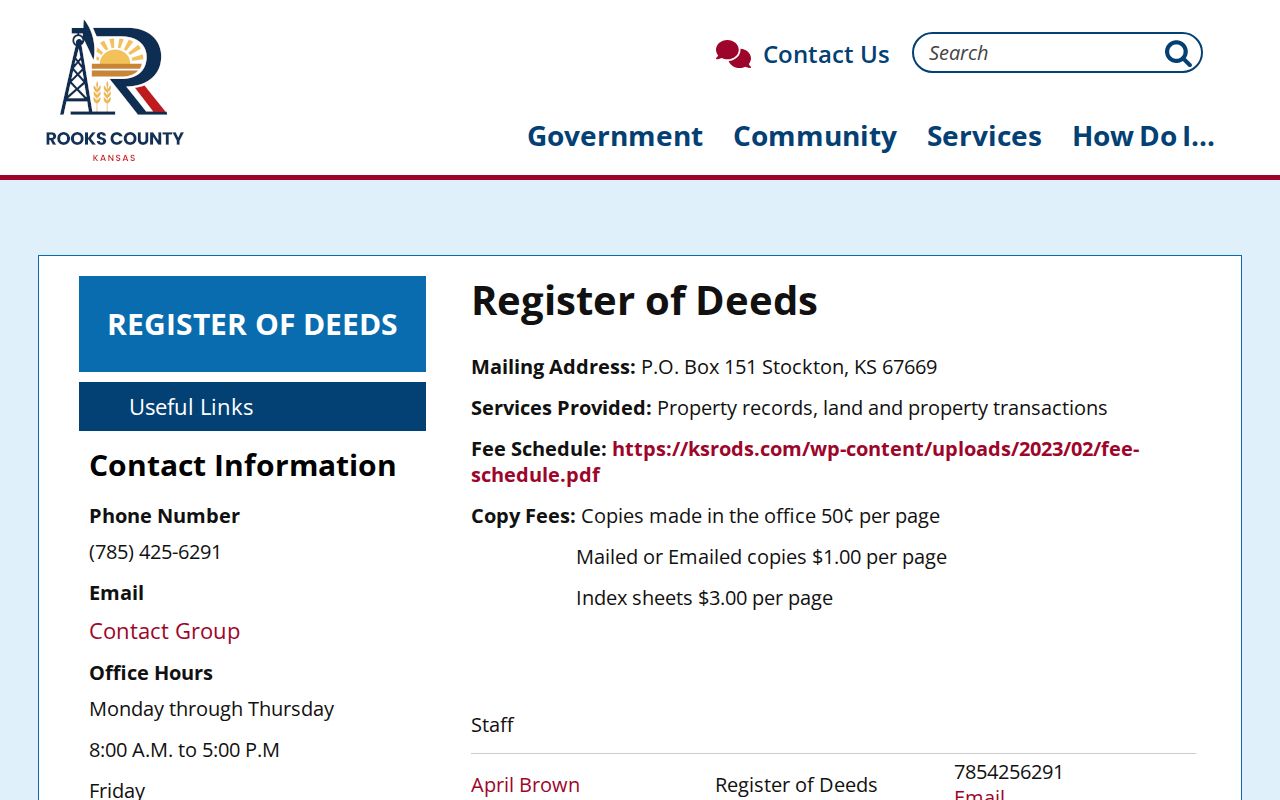
The Rooks County recorder keeps no online deed index. Instead, the office works from a parcel number and legal description, which ORKA supplies. So start there. A phone call to the recorder at 785-425-6291 works too. The counter sits at 115 N Walnut Street in Stockton. Mail goes to PO Box 151, Stockton, KS 67669.
Have your details ready before you call. Give the staff the name, land description, approximate recording date, and instrument type. Ask them to quote the certified-copy charge. The published page lists only ordinary copy rates.
Follow the Rooks Grantor-Grantee Chain
The grantee receives the stated interest. The grantor conveys it. Start with the newest deed into the current roll owner, then work backward through each named grantor's own acquiring deed. Match the legal description at every step, since one person may have held several tracts in the county.
- Ask for the latest deed naming the current roll owner as grantee.
- Record its date, parties, instrument or book/page reference, and exact land description.
- Search the grantor as a prior grantee and repeat the match.
- Branch to probate, trust, entity, or life-estate instruments when the chain changes form.
- Use deed books and archival sources when the office's current index route ends.
- Grantor
- The party that conveys the stated interest.
- Grantee
- The party that receives the stated interest.
- Chain of title
- The linked sequence of recorded transfers for the same land.
- Book/page or instrument number
- A recorder reference used to retrieve a filed document.
Match Rooks Legal Descriptions
An address is only a finding aid. The legal description ties a deed to land. City property may cite a named addition, block, and lot. Rural ground may use section, township, range, quarters, metes and bounds, or survey calls. Compare the wording, not the owner's name.
Plainville's named additions, Stockton's Woods Addition, and Palco's Original Townsite give concrete examples. Some old street or annexation descriptions do not track modern labels. Where language differs, pull the referenced plat or ordinance. Compare it with the ORKA parcel layer. A map screen supplies context, never a surveyed boundary.
Check Liens Beside Rooks Deeds
Ask separately for mortgages, releases, mechanic's liens, judgment liens, real-estate tax liens, federal tax liens, easements, rights-of-way, covenants, fixture filings, and lis pendens notices. The recorder's public page does not say which categories carry separate indexes. Search current and former owner names. Search the parcel description too.
Record the original recording date and number. Note the parties, the property description, and any amount shown. Add any later release date and number. A court case may be needed for a judgment or enforcement action. A state UCC search adds entity and fixture context. It is still not a complete real-estate title search.
Rooks Estates Can Split the Trail
An estate or trust transfer may take three records. One is the deed recorded against the land. Another is the District Court order or probate file showing authority. A restricted vital certificate applies when eligibility is met. A will alone never changes record title. Watch for an executor or administrator deed, affidavit, transfer-on-death instrument, or survivorship wording.
Use the Kansas court portal and the courthouse terminal as docket leads, then ask the clerk for the public petition, order, or judgment. Sensitive attachments can stay restricted. Return to the recorder for the instrument that actually changed the land record.
Older Rooks Deed Books Stay Offline
Rooks County was formed in 1867. It was organized in 1872, but no book-by-book inventory is published. The recorder vault holds original books and indexes. The Kansas Historical Society adds tract-book guidance, original land surveys, field notes, plats, and railroad land-sale records.
Libraries, newspapers, census collections, cemetery abstracts, and FamilySearch place searches can surface names or dates. Those names or dates can unlock an older deed. Webster Dam submerged the historic town of Webster in 1950, so the name may persist in land and family records without matching any current parcel. Historical context narrows the search. It does not replace the instrument.
Rooks Deeds and Court Orders
A recorded notice may point to a foreclosure, quiet-title, partition, probate, or lien case in District Court. Search the Kansas portal by party, use the courthouse terminal when the web result is thin, and record the case number, roles, filing date, type, and status before asking the clerk for documents.
Match the court's legal description to the recorder's instrument. A petition states a claim. A judgment states the decision. A sale return marks a later step. A release or deed may then be recorded, so these stages must not collapse into one transfer date. Sealed matter stays closed, and no local court-copy fee is published.
Make a Precise Rooks Copy Request
A precise request gets better results. Give the Rooks County recorder every spelling you know. Include the grantor or grantee role, the recording window, the deed type, and the legal description. A book and page reference or instrument number helps enormously. Also state which format you want. That could be an index sheet, a plain image, a certified copy, or a retrieval from an older volume.
Kansas open-records law reaches beyond routine counter service. It allows actual-cost fees and charges for staff time. It also permits advance payment and an itemized explanation of what you paid for. Your request must contain enough detail to single out the record. The recorder has no duty to draft a title opinion or assemble a new abstract.
Order a Rooks County Deed Copy
Ordering a deed copy from Rooks County starts with specifics. Hand the recorder the party names, parcel ID, legal description, and a rough date. Include any recording reference you have. Pricing is simple. An in-office copy runs 50 cents per page. Mailed or emailed copies cost $1 per page. An index sheet is $3 per page. Before sending money, ask the office to confirm the page count, delivery method, and payment form. Also confirm any certification charge.
Routine service can fall short of an open record. A focused Kansas Open Records Act request is the next step. K.S.A. 45-219 allows actual-cost and staff-time charges, advance payment, and an itemized fee explanation. Aim the request at one instrument or a tight date and name range. The recorder is not obligated to assemble a title report on request.
Recorded, not guaranteed. Rooks County deed records show filed instruments. They do not certify clear title, resolve every interest, or replace legal review.