
Trace Former Rooks County Owners by Record Era
Every backward chain begins at the Rooks County Register of Deeds, branching out only when a deed points somewhere else. The office publishes no exact deed-book or online coverage years. So describe access by source rather than guessing dates.
| Source | Years It Covers | Where Held | What It Shows |
|---|---|---|---|
| Deed index and instruments | County history; exact run unpublished | Register of Deeds | Grantor, grantee, date, deed type, legal description |
| Deed books / paper indexes | Older era; book-by-book inventory unpublished | Recorder vault/counter | Earlier transfers and book/page trail |
| Historic plats and surveys | Varies by townsite or filing | Recorder, county files, KSHS | Lots, blocks, streets, alleys, dedications |
| Tax and assessment rolls | Retention not published | Appraiser, Treasurer, archives | Year-specific owner-of-record clue |
| Newspapers and censuses | Named historical runs | KSHS, libraries, FamilySearch | Occupant and event context, not title |
Whatever the era, anchor the work in a verified deed reference. A plat resolves things when an addition or street changed. Probate fills the gap when an estate interrupts the chain, and newspapers or censuses simply explain the people and places between recorded events.
Enter the Rooks Deed Books at the Counter
Rooks County offers no public online grantor-grantee search, and no cutoff year is published. The recorder sits at 115 N Walnut Street in Stockton. Call 785-425-6291, or write to PO Box 151. Copy charges run 50 cents per page in office. Mailed or emailed pages cost $1 each. Index sheets cost $3.
Bring the parcel ID, legal description, current owner of record, situs address, and an approximate date. Request the newest deed first and keep its book, page, or document number close. A missing web index is an access fact. It is not evidence that older deed records are absent.
The official Register of Deeds page carries the current counter contact and the published copy terms for anyone working through the deed books in person.
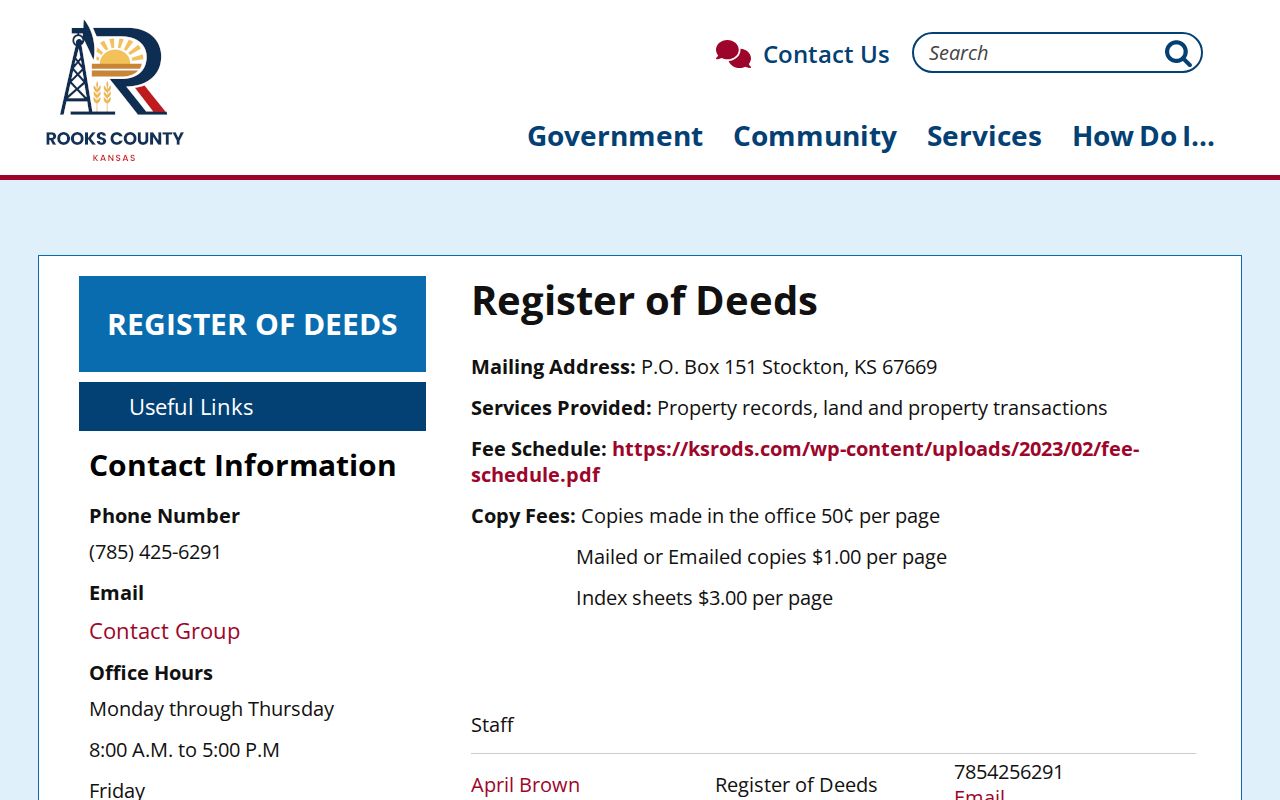
That office page lays out the offline route a previous-owner chain requires. When the web runs dry in Rooks County, the counter is where the deed records continue.
Walk the Rooks County Deed Chain Backward
Treat each transfer as a dated link in one long chain. A solid research table captures Transfer Date, Grantor and Grantee, deed type, book/page or instrument number, and the legal description. Never push forward on a name alone once the legal description changes.
- Find the current owner’s acquisition deed, where that owner appeared as grantee.
- Record its grantor as the immediately prior owner and copy the complete legal description.
- Search that grantor as an earlier grantee, testing initials, entity names, and name variants.
- Repeat through book/page references; when digital access stops, continue in paper indexes and deed books.
- Grantor / grantee
- The conveying party and receiving party named in a deed.
- Chain of title
- The ordered sequence of instruments affecting ownership.
- Reverse index
- An index organized to locate the other party and work backward.
- Warranty / quitclaim deed
- Different conveyance forms; neither alone substitutes for a title opinion.
- Legal description
- The durable land identity when a street address changed or was absent.
Bridge Probate Breaks in the Ownership Chain
A death can split the evidence across three custodians. The recorder holds the executor's deed, affidavit, transfer-on-death instrument, or other land filing. Rooks District Court may hold the estate case. It may also hold its orders, the representative's papers, inventory, or authorization. Kansas OVS keeps restricted certificates under K.S.A. 65-2422d.
Expect a trustee, corporation, estate name, or life tenant to break a tidy surname sequence. Follow the representative capacity and the legal description. Do not mistake a will or death certificate for a deed. The state court portal and the courthouse public terminal are separate channels. Some public case information appears only at the terminal.
Carry Legal Descriptions into Older Land Sources
The Kansas Historical Society land guide opens the door to county land sources. It covers deeds, tract books, original surveys, plat maps, field notes, and railroad land-sale collections. A city lot may appear as lot and block within an original townsite or addition. Rural acreage may carry section-township-range or metes and bounds instead.
Local geography matters here. Stockton records reference the Original Townsite and Woods Addition. That includes a Walnut vacation tied to Block 33. Plainville's RGH Addition was described through ordinance and legal description after annexation. It has no conventional plat. Such quirks explain why a current street address may not surface in an old index. Carry the legal description from deed to deed.
Reconstruct the Household Around a Former Owner
A deed supplies a name and a year. Historical media can round out the household from there. FamilySearch holds Rooks County in the 1905 and 1915 Kansas state censuses. Statewide cemetery abstracts add names, dates, ages, and relatives. The KSHS newspaper catalog supports searching by county, title, and date range.
Plainville's digital archive lists 77,408 pages. It spans the 1904-2025 Plainville Times run plus earlier Plainville titles. Newspapers, directories, cemeteries, and censuses show who lived at or near a place. They do not prove ownership. Pair every household clue with a deed or tax roll year.
Note: A 1905 or 1915 census can bridge quiet years between deeds. It cannot replace the recorded chain.
The 1915 Kansas state census catalog entry includes Rooks County as a historical cross-reference.
That catalog helps separate household-history sources from the deed evidence that actually establishes former ownership in Rooks County.
Preserve Rooks County Place Names That Outlived Parcels
Rooks County was established in 1867 and organized in 1872. Its records have passed through original books and plats. They also moved through paper indexes and local collections. Modern GIS came later. The Kansas Historical Society notes that Webster Dam submerged the town of Webster in 1950. So a deed, cemetery record, newspaper item, or census can still carry the name "Webster" long after the settlement vanished.
No courthouse fire is documented. No defined deed-book loss is documented either. And no recorder imaging cutover is published. Assume neither. Mark any missing interval. Then ask the Register of Deeds or KSHS whether the deed books were reindexed, microfilmed, lost, or moved.
Define How Far Back Rooks Ownership Records Go
The official history supports county records from organization forward. It publishes no deed-book-by-book run and no online start year. Work backward until the recorder's chain reaches an original entry or its documented limit, then lean on tract books, original survey material, railroad land-sale files, and federal-land context for the earlier origin. Along the way, record the custodian and coverage of every source consulted.
Coverage and lawful use. No Rooks online cutoff year is published; older owners may require counter books and archives. Use former-owner research for legitimate history, estate, and property diligence - not to track or harass a living person.