
Follow a Plainville Address Through Property Records
Plainville property records live at the county level. There is no city assessor or recorder handling them. Start in ORKA and hold onto the parcel ID and legal description. Then turn to the county custodians for title, value, and tax evidence. Plainville City Hall is the last stop. That office handles permits and zoning.
- Search the Plainville situs address in ORKA and save the Rooks County parcel ID.
- Copy the legal description and run the owner separately when an address match is weak.
- Ask the Register of Deeds for the latest instrument and any named-addition plat.
- Confirm assessment and tax fields with the Appraiser and Treasurer.
- Request Plainville permit and zoning files by address, work type, and date range.
A deeper walkthrough of the Rooks County property search shows how each record fits together. For Plainville, the practical step is reading county results in the city's own addition and permit vocabulary.
County Custody and Plainville's City Files
The Rooks County Appraiser and ORKA cover parcel, owner, situs, mapping, and value data. The Register of Deeds holds deeds, mortgages, easements, releases, and plats. The Treasurer holds tax information. Plainville handles its own city files. It administers building permits, zoning, official maps, and its own KORA responses.
Rooks County land records
The Stockton courthouse offices hold title, appraisal, and tax records for every Plainville parcel.
Plainville permits and zoning
City Clerk and Public Officer
Plainville, KS 67663
Request current phone and counter hours from the city.
Plainville Addition Names Are Search Keys
The zoning code names the 1962, Fischer, Fischer-Sutor, Griffin's First, Second and Third, Freeman & Cooper's, Santa Fe and Plainville Land and Lot Company, and Shelton's additions. The code also names Arnhold's Addition. These are legal-description terms, not casual neighborhood names.
A county address result may use a current street number. Its deed may use an addition, block, and lot. Search both forms. Then request the recorded plat. The zoning code does not supply a full book-and-page index.
RGH Addition Preserves an Unusual Plainville Annexation
A Kansas Attorney General opinion addresses RGH Addition, land that Plainville annexed without a conventional plat. That makes the ordinance itself the trail. Its legal description stands in for the missing subdivision plat, so a searcher follows ordinance text rather than a recorded map when working through this slice of Plainville property records.
This city-edge quirk rewards a three-way check: the ordinance description, the ORKA polygon, and the county deed. The county publishes no complete annexation chronology, so the parcel number and deed records carry the weight.
Plainville's 67663 ZIP Does Not Draw the City Line
ZIP 67663 is a delivery geography, nothing more. Rural land can carry Plainville as its postal city while sitting outside municipal limits. A mailing address can also point somewhere other than the parcel situs.
Use the USPS lookup for delivery questions. Use ORKA for the mapped location. Check the city ordinances or a filed map for true municipal status. Keep the situs, the mailing address, and the legal description in separate notes when you search Rooks County property records by address.
Plainville Subdivisions in Deeds, Codes, and Plats
Plainville's named additions trace how the town grew from its railroad-era core. Their value is practical. An addition name on an old deed can recover a parcel when the instrument carries no modern street address, which makes deed records and the plat books a durable path into Rooks County property records.
| Neighborhood / Subdivision | Era | In the Records |
|---|---|---|
| 1962 Addition | Mid-20th century name | Code references tracts 10, 11, 17, and 18 |
| Fischer and Fischer-Sutor Additions | Not stated | Fischer includes east halves of Blocks 1 and 2 |
| Griffin's First, Second, and Third | Not stated | Search exact ordinal and addition name |
| RGH Addition | Annexation documented by 1980 opinion | Ordinance and legal description may replace conventional plat trail |
Check each subdivision name against the ORKA subdivision layer. Then pull the actual plat or annexation instrument. A tax polygon is not a survey, and the Rooks County parcel map guide explains the difference.
Plainville Permit Fields Build an Improvement History
A city permit file can fill gaps that a deed leaves open. Plainville's published building-permit rules ask for the owner name, the property location, and a description of the proposed work. Applicants also list outside dimensions for each floor and the basement, occupancy, construction details, and materials. Estimated cost, start and completion dates, and contractor names and addresses round out the form.
| Request field | Why it matters | How to ask |
|---|---|---|
| Property location and owner | Matches file to parcel | Give both plus legal description if known |
| Work and dimensions | Shows project scope | Ask for application and approved plan |
| Start and completion dates | Places improvements in time | Set a practical date range |
| Contractor and materials | Adds construction context | Request attachments and inspections |
Plainville requires a permit before covered building, remodeling, demolition, or moving work begins. The code sets a twelve-month expiration on permits. It also lists a $20 charge for building or remodeling work valued at $100 or more.
Plainville's Permit Hub Is a Form Index
Plainville's permit page works as a form index rather than a results database. It links building, urban chicken, ADT alert, open-records, and yard-burning forms. What it does not offer is any kind of lookup. There is no address search and no permit-number query. No status filter exists, and there is no document viewer or export. Public payment results are absent too. Anyone digging into a property's history has to go through the office directly.
A focused request gets the best results. Include the address, the owner if known, the permit type, and a date range. Say plainly what record you want. That could be the application, an approval, an inspection record, a denial, or a zoning decision.
The official permit hub displays the city forms that are available.
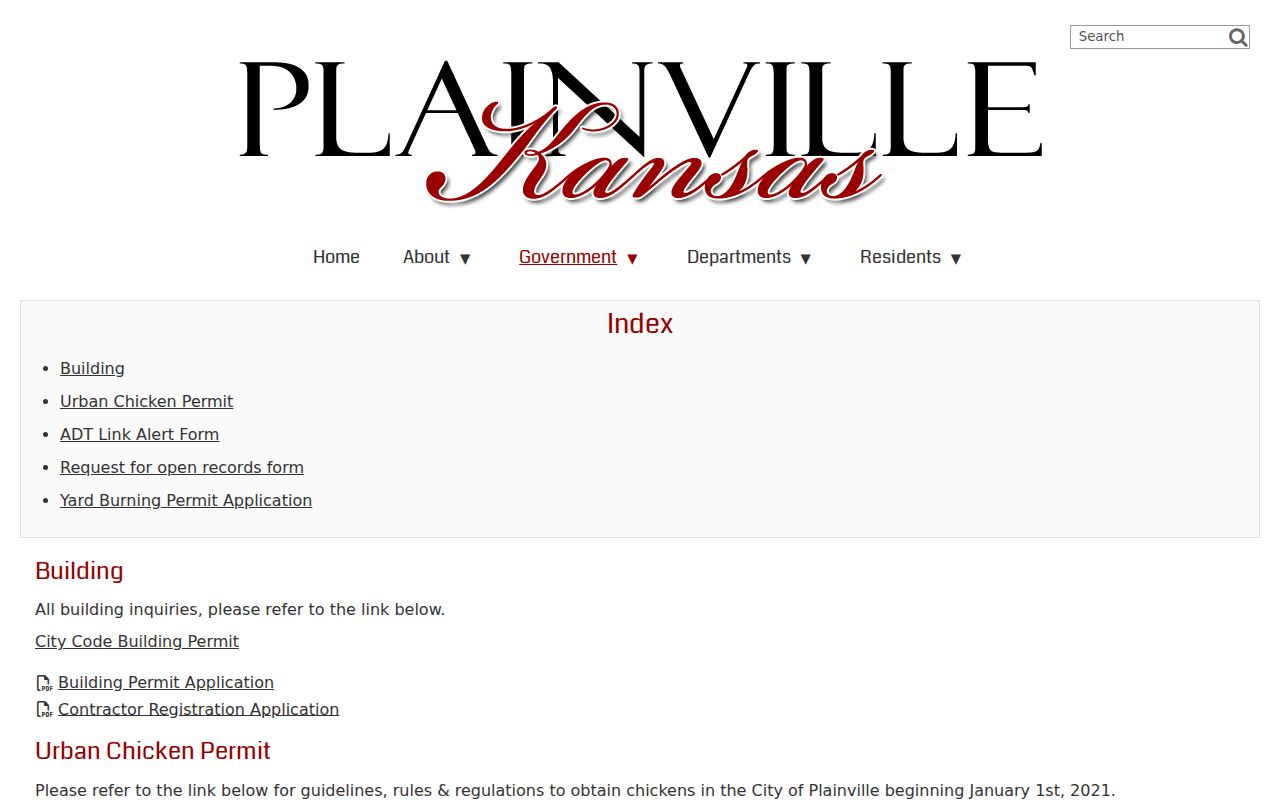
The page lists the city's request forms. It confirms the official route for filing.
A direct record request is still needed for results. The index alone returns no documents.
Plainville Newspapers Bridge Old Address Gaps
The Library of Congress record places the historic Plainville Times at 1886. Plainville Memorial Library can help with local history, newspapers, and archives. It also offers genealogy help, copying, scanning, and interlibrary loans. A newspaper item can tie an owner or business name to an older street description. Founded in 1877, the town grew with the railroad. That growth helps explain its layered addition names.
Treat that evidence as an address clue, not title. Confirm it with a deed, plat, assessment, or census.
Plainville Value Trends Need Parcel-Level Confirmation
Rooks County's 2025 market study pointed upward for residential, commercial, and vacant-lot values. But the county publishes no city-only Plainville revaluation table. Use the notice as context, never as the value of a single lot. For a Plainville parcel, record the class and the January 1 appraisal year. Also note appraised value, assessed value, and any exemption flag. Compare permits and condition evidence before explaining a change.
Plainville property records can establish the county owner of record and the legal description. They also cover recorded interests, assessed figures, the mapped tax parcel, and the city permit trail. What they cannot do is prove clear title, an exact surveyed boundary, present occupancy, structural safety, or current market price.
What Plainville Property Records Can Establish
Plainville property records can establish the county owner of record, the legal description, recorded interests, assessed figures, the mapped tax parcel, and the city permit trail. What they cannot do is prove clear title, an exact surveyed boundary, present occupancy, structural safety, or current market price.
Lawful use. Use Plainville property records for due diligence, boundary research, history, and civic transparency. They are not a title search, and owner information must never be used to harass or target anyone.